Artificial intelligence has spent most of its recent boom inside screens. AI robotics is what happens when those increasingly capable models are asked to deal with the physical world instead.
That is a much harder problem. A robot cannot simply generate a plausible answer. It has to perceive an environment, decide what to do and move through reality without breaking the object, itself or the person standing nearby.
Robots need more than better mechanics
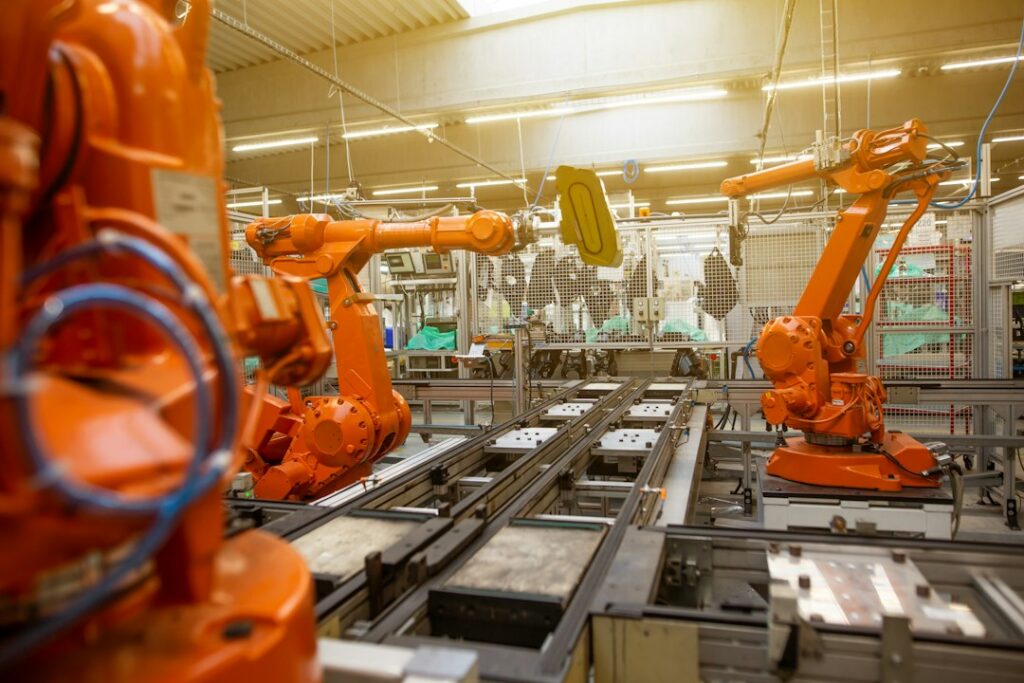
Traditional industrial robots are extremely useful because they operate in controlled environments. They can repeat the same motion thousands of times with remarkable precision.
The challenge is flexibility. Real homes, warehouses, hospitals and construction sites are messy. Objects move. Lighting changes. Instructions are ambiguous. The machine needs to understand what it sees and adapt.
That is why advances in multimodal AI matter to robotics. Models that can process images, language and other sensory information offer a richer foundation for perception and planning.
Vision-language-action models are an important shift
Google DeepMind describes Gemini Robotics as a vision-language-action model designed to bring advanced AI capabilities into physical systems.[1] The idea is to connect visual understanding and language instructions with actions a robot can execute.
Instead of programming every movement in advance, a user might give a higher-level instruction, such as putting a group of objects away, while the system determines the sequence of actions required.
That does not eliminate engineering. It changes where the intelligence sits.
The physical world is less forgiving than a chat window
A chatbot can correct a sentence. A robot that misjudges a shelf, tool or person can cause damage. Physical AI therefore raises a different reliability standard.
Models need to understand space, object relationships, force, timing and uncertainty. They also need safeguards that constrain what actions are possible and when human approval is required.
This is one reason progress in robotics can look slower than progress in text generation. The cost of being wrong is higher, and testing is more difficult.
Warehouses and factories are natural early markets
Industrial environments provide a useful middle ground. They are structured enough to control risk but varied enough to benefit from more adaptable machines.
AI-enhanced robotics can potentially help with picking, sorting, inspection, movement of goods and tasks that change too frequently for traditional fixed automation. The economic value is straightforward: a more adaptable machine can address a wider set of jobs without being reprogrammed from scratch every time.
Humanoid robots get attention, but form follows function
Humanoid robots attract headlines because they resemble people. The commercial question is less theatrical: does the human form help the machine work in environments built for human bodies?
Stairs, door handles, shelves, carts and tools were designed around human dimensions. A humanoid form can therefore make sense in some existing spaces. In other environments, wheels, fixed arms or specialized machines will remain simpler and more efficient.
The future of AI robotics is unlikely to be one universal body.
Better models could make robots easier to train
One of the biggest costs in robotics is teaching the system what to do. If a robot can learn from demonstrations, language instructions, video and simulation, the training process can become more flexible.
Google DeepMind’s broader model portfolio reflects this convergence between multimodal understanding and physical AI, including dedicated robotics systems alongside general Gemini models.[2]
The long-term opportunity is a machine that can generalize skills rather than memorize one exact movement.
Robotics will test whether AI understands the world
Language models can sometimes hide weak reasoning behind fluent prose. Physical action is harder to fake. If a robot is asked to clear a table, either the table gets cleared or it does not.
That makes robotics an unusually concrete benchmark for AI progress. Perception, planning, memory, reasoning and control all have to work together.
The market is broader than humanoids
AI robotics includes autonomous vehicles, drones, industrial arms, warehouse systems, medical devices, agricultural machines and many forms that do not resemble people at all.
The common thread is intelligence moving into machines that sense and act. As models improve, more physical tasks become candidates for automation or assistance.
What to watch
The most important signals will not be dramatic demo videos. They will be reliability, cost, deployment scale and the range of tasks a system can handle outside carefully prepared conditions.
AI has already changed what software can do with information. Robotics asks a bigger question: what happens when that intelligence starts moving things in the real world?
Sources
[3] Google DeepMind, “Model cards”
Build your AI fluency.
In the AI Era™ Professional Learning is a five-level certification pathway designed to help professionals move from understanding AI to applying it with greater confidence, productivity, and sophistication.