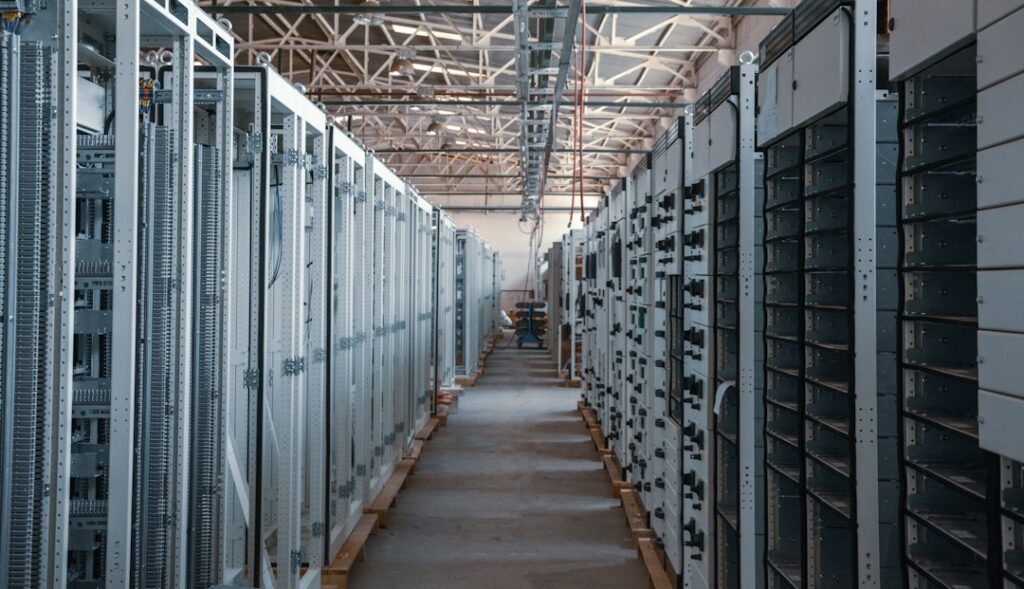
The AI boom is usually described in software terms: better models, faster assistants, smarter agents. But the most important constraints are increasingly physical.
AI data centers need chips, electricity, cooling, land, networking and grid connections. As demand for artificial intelligence grows, those inputs are becoming strategic assets. The race to build better AI is also becoming a race to build the infrastructure underneath it.
AI needs an enormous amount of physical capacity
Training and running advanced AI systems requires specialized computing hardware housed in data centers. The faster AI use grows, the more infrastructure companies need to support inference, model training and the services built on top of them.
The International Energy Agency says global electricity generation used by data centers could grow from about 460 terawatt-hours in 2024 to more than 1,000 terawatt-hours by 2030 in its base case.[1] That projection makes the issue larger than a technology-sector concern. It is becoming an energy-planning question.
Compute is becoming a strategic resource
AI companies compete on model quality, but access to high-performance computing increasingly shapes how quickly they can train, test and deploy those models. Specialized accelerators are expensive, and the infrastructure around them is equally demanding.
That creates a different kind of competitive advantage. A company with excellent software but limited compute can be constrained by hardware availability. A company with capital, data-center capacity and long-term chip supply can iterate faster and serve more users.
Power is moving to the center of the conversation
The electricity demand is not abstract. Data centers need reliable power every hour of the day, often at scales that can strain local infrastructure. The IEA reported in 2026 that capital spending by five large technology companies exceeded $400 billion in 2025 and was expected to rise sharply again in 2026, driven in part by data-center investment.[2]
That helps explain why technology companies are increasingly discussing energy contracts, grid access, natural gas, renewables and nuclear power in the same conversations as GPUs and models.
The bottleneck is often the grid, not the building
A data-center campus can be planned faster than new transmission lines or major power infrastructure can be approved and built. Grid interconnection queues, transformer availability and local permitting can therefore become practical limits on AI expansion.
This is one reason location matters. The best place for an AI data center is not simply where land is cheap. It is where sufficient power, fiber, water or alternative cooling systems, permitting and workforce can come together on a realistic schedule.
Cooling and water matter too
High-density computing produces heat. Operators have to remove that heat efficiently, which can mean sophisticated air cooling, liquid cooling or other approaches depending on the facility and hardware.
Water use has also become part of the public discussion around data-center growth. The exact footprint varies widely by climate, cooling design and power source, so sweeping claims can be misleading. What is clear is that AI infrastructure planning now has to account for resources beyond electricity alone.
Why smaller, more efficient models matter
Infrastructure pressure is one reason the industry is investing heavily in efficiency. OpenAI’s GPT-5.4 mini and nano, for example, are positioned for workloads where latency and cost matter, while Google similarly offers multiple Gemini model sizes aimed at different performance and scale requirements.[3][4]
Using a giant model for every request would be economically inefficient. More mature AI systems increasingly route simple work to smaller models and reserve expensive frontier models for tasks that genuinely need them.
The AI economy is becoming an industrial economy
This may be the most important change in how to think about artificial intelligence. AI began as a software story, but scaling it requires industrial investment. Chips have to be fabricated. Facilities have to be built. Power has to be generated and transmitted. Equipment has to be cooled and maintained.
That creates opportunities far beyond model developers. Utilities, construction firms, chipmakers, networking companies, cooling specialists and energy developers are increasingly part of the AI supply chain.
What happens next
The next phase of AI growth will depend partly on whether infrastructure can keep pace with demand. Faster chips help, but they do not eliminate the need for power. Better models help, but large-scale deployment still requires servers and networks.
The companies that win the AI race may therefore be determined by more than who builds the smartest model. Access to reliable, affordable infrastructure is becoming part of the product strategy itself.
Sources
[1] International Energy Agency, “Energy supply for AI”
[2] International Energy Agency, “Data centre electricity use surged in 2025”
[3] OpenAI, “Introducing GPT-5.4 mini and nano”
Build your AI fluency.
In the AI Era™ Professional Learning is a five-level certification pathway designed to help professionals move from understanding AI to applying it with greater confidence, productivity, and sophistication.