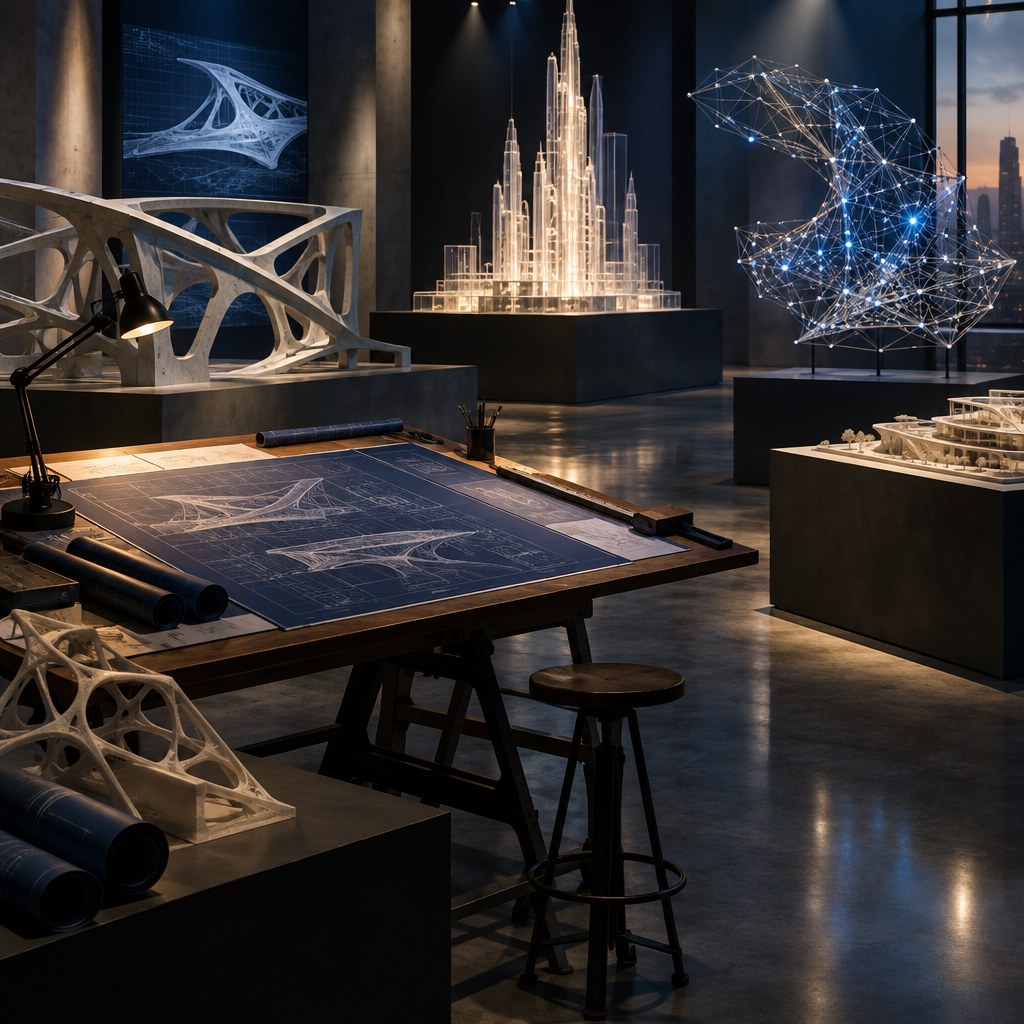
Every technological era eventually acquires its cast of characters.
Industrialization had inventors with oil-stained cuffs. The personal-computer age had men in garages. The internet preferred hoodies. Artificial intelligence has produced something more difficult to photograph: a collection of researchers, founders and infrastructure builders whose work increasingly determines what the rest of us will be able to do with software.
There is no single architect of the AI era. There are competing blueprints.
Sam Altman is building toward scale
OpenAI’s public argument has increasingly centered on distribution: powerful AI should become broadly useful rather than remain confined to laboratories or a small number of institutions. In a 2026 statement of principles, Sam Altman framed the company’s goal around putting increasingly capable AI into the hands of as many people as possible.[1]
That ambition explains much of OpenAI’s strategy. Models matter, but so do products, infrastructure, partnerships and the systems that make AI part of everyday work. The architecture is not simply intelligence. It is access.
Dario Amodei is building around reliability
Anthropic’s Dario Amodei represents a different emphasis. Anthropic describes him as co-founder and chief executive officer, leading the company’s research direction and strategic vision around AI systems designed to be reliable, interpretable and steerable.[2]
Those words are less cinematic than “superintelligence,” but they point toward a practical challenge that grows with capability. The more authority software receives, the more important it becomes to understand why it behaves the way it does and where it should stop.
That question becomes especially important as AI shifts from answering questions to taking actions.
Demis Hassabis is building toward science
Google DeepMind’s Demis Hassabis has long treated artificial intelligence as more than a productivity technology. Google DeepMind describes its mission in terms of building AI responsibly to benefit humanity and using advanced systems to help solve scientific and engineering problems.[3]
The legacy of AlphaGo remains instructive. A system built to master a board game helped establish techniques that later influenced work in protein structure prediction and other scientific domains. In 2026, Hassabis wrote that the decade since AlphaGo had reinforced DeepMind’s belief that increasingly general AI could become a tool for science, medicine and productivity.[4]
His blueprint asks a larger question than how much time AI can save in an office. It asks what problems become solvable when machines can reason across domains humans have struggled to model.
Jensen Huang is building the physical layer
Artificial intelligence can feel intangible until you remember that it requires enormous amounts of hardware, energy and infrastructure.
NVIDIA founder and CEO Jensen Huang has become one of the defining figures of the era because his company sits beneath so much of the modern AI stack. NVIDIA says its accelerated-computing platforms have become core infrastructure for generative AI and other forms of machine learning.[5]
At GTC 2026, Huang described AI as essential infrastructure rather than a single application or breakthrough.[6] That framing is useful. The models people interact with are only the visible layer. Beneath them sit chips, networking, data centers, software frameworks and energy systems.
Someone has to build the roads before everyone can drive.
Amjad Masad is building for the person who could not build before
Replit founder and CEO Amjad Masad represents another important branch of the AI era: software creation moving beyond professional programmers.
Replit began with the idea that programming environments should be easier to access. In 2026, Masad described the company’s broader ambition as allowing people to turn imagination into working software without first mastering the traditional development stack.[7]
That shift may prove culturally significant. For decades, software was one of the most consequential forms of creation that remained gated by a specialized technical language. AI coding agents are beginning to weaken that gate.
The result will include terrible software. It will also include software that would never have existed because the person with the idea was not a developer.
The architecture is increasingly about permission
What connects these figures is not agreement. It is influence over what becomes possible.
One group is pushing capability. Another is pushing safety and controllability. Another is building infrastructure. Another is trying to make software creation accessible to people who previously could not participate.
These are technical decisions, but they are also cultural ones. A model’s context window changes how we work with information. An agent’s permissions change how much work software can do without us. A coding tool changes who is allowed to create an application. A cheaper chip changes who can afford to train or run a model.
The AI era will be designed by more than its most famous names
The temptation is to turn technological history into biography, as though a handful of founders personally invented the future. They did not, and they will not.
Behind every visible executive are researchers, engineers, product designers, infrastructure teams, open-source contributors, academics and users who discover what the technology is actually for.
Still, architecture matters. Certain people get to make choices earlier than the rest of us. They decide what to fund, what to ship, what to withhold and what kind of future deserves to be built.
The AI era will eventually feel ordinary. Most transformative technologies do. We will stop marveling that software can reason, generate and act, just as we stopped marveling that a phone can find almost any piece of information on Earth.
Until then, it is worth watching the architects. Not because they control the future, but because they are drawing some of its first plans.
Sources
[1] OpenAI, Sam Altman, “Our principles”
[2] Anthropic, “Leadership at Anthropic”
[3] Google DeepMind, “About Google DeepMind”
[4] Google DeepMind, Demis Hassabis, “From games to biology and beyond: 10 years of AlphaGo’s impact”
[6] NVIDIA, “NVIDIA CEO Jensen Huang and Global Technology Leaders to Showcase Age of AI at GTC 2026”
[7] Replit, Amjad Masad, “The Future is Actually Very Human”
Build your AI fluency.
In the AI Era™ Professional Learning is a five-level certification pathway designed to help professionals move from understanding AI to applying it with greater confidence, productivity, and sophistication.