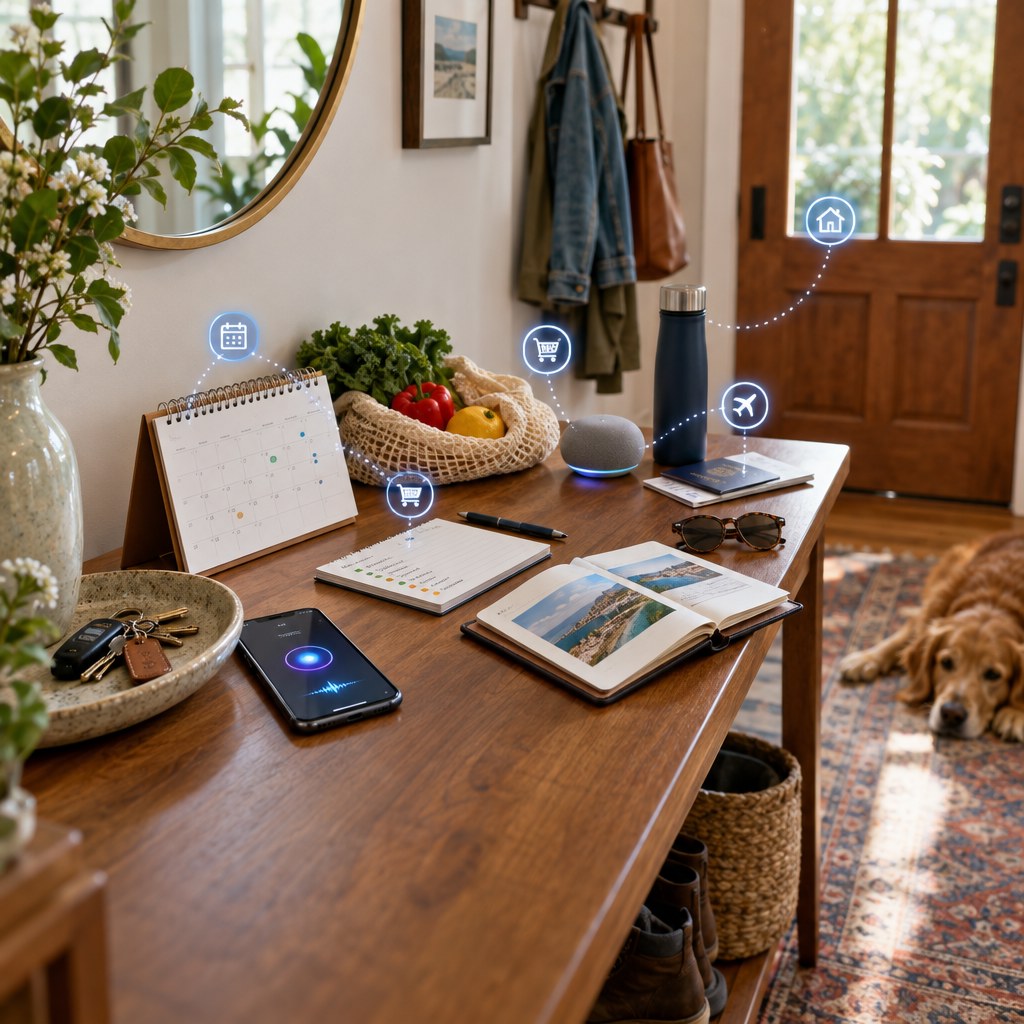
The digital assistant has always suffered from a slight credibility problem. For years, we were told we had assistants living inside our phones. Mostly they set timers. This was useful. I set many timers. But if a human assistant’s principal skill were reminding me that the pasta had been boiling for eleven minutes, there would eventually be a performance conversation.
The new generation of AI assistants is trying to change that. They can increasingly search across personal information, remember context, work with other applications and carry tasks beyond a single answer. Apple released Siri AI in beta in September 2026 with personal context understanding, onscreen awareness and more systemwide app actions, while Google has been connecting Gemini to personal information across its ecosystem and adding more agentic capabilities.[1][2][3] We appear to be getting the personal assistants we were promised. This raises the obvious question: what exactly are we going to ask them to do?
The assistant is finally learning where you left things
One of the least glamorous but most compelling uses of a personal AI assistant is retrieval. Human life now has an administrative layer. The hotel confirmation is in email. The photo of the paint color is somewhere in Photos. Someone texted you the restaurant name. The receipt is in another inbox. The document you need is definitely saved, which is a comforting fact right up until you need to locate it.
Apple says Siri AI can use personal context across messages, emails, photos and more to surface relevant information and take more actions across applications.[1] Google’s Personal Intelligence takes a similar approach. With permission, Gemini can connect information from Gmail, Photos, YouTube and Search to produce more personalized answers.[2]
This may be the first genuinely persuasive argument for an assistant that “knows you.” Not because I need software to understand my soul. I need it to remember which email contains the confirmation number.
Personalization is useful right up until it becomes weird
An assistant with context can do things a generic chatbot cannot. It can theoretically understand that when you ask about “the trip,” you mean the trip contained in your flight confirmation and hotel email. It can know which products you already bought, which appointments are on your calendar and which information may be relevant without requiring you to reconstruct your life in the prompt box.
This is powerful, but it is also the moment privacy stops being an abstract paragraph in a terms-of-service agreement. Google says Personal Intelligence connections are optional and users control which applications are connected. The company also acknowledges that the system can make mistakes or “over-personalize,” including drawing the wrong conclusions from information it finds.[2] That last part feels wonderfully human. Apparently even artificial intelligence can look at several hundred photographs and misunderstand the relationship.
The real breakthrough may be action, not conversation
The first generation of generative AI was mostly impressive because it could answer. The next generation is increasingly interesting because it can do. Google announced Gemini Spark in 2026 as a personal AI agent designed to proactively manage tasks under the user’s direction, while Apple is expanding the number of actions Siri can perform across applications.[3][1]
That difference matters. There is only so much productivity to be gained from having software explain how to organize your inbox. Eventually it needs to organize something. A useful AI personal assistant might monitor information you care about, prepare a morning brief, keep track of a project, find things across applications, make a draft reservation plan or remind you that the warranty you spent twenty minutes locating expires Friday. Those are not world-changing activities. They are life-changing in the very specific sense that life contains hundreds of annoying little activities.
There is a danger in optimizing absolutely everything
The productivity industry has an impressive ability to turn saving time into a hobby that consumes time. AI is vulnerable to the same problem. You can now spend an evening building an elaborate AI workflow designed to save seven minutes every third Thursday. This is technically productivity. It is also arts and crafts for adults who own too many browser tabs.
The useful test is boring: does the assistant remove something you would otherwise have to remember, locate, organize or repeatedly do? If yes, wonderful. If maintaining the system becomes another responsibility, you have hired an assistant who requires management.
AI assistants will probably become less visible
The most important development may be that we stop thinking of these systems as destinations. Today, using AI still often means opening an AI application. Tomorrow’s assistant is more likely to appear where the need occurs.
Google has been expanding connected apps in Gemini and AI Mode in Search so people can interact with outside services without constantly switching contexts.[4] Apple is building Siri more deeply into the operating system. The assistant slowly disappears into everything else. That is probably when it becomes genuinely useful. The best household appliance is rarely the one you spend the day admiring. It is the one that quietly stops you from doing something tedious.
Will they make life easier?
Yes, probably. They will also create entirely new annoyances, because technology has never signed an agreement preventing this. We will forget which assistant knows what. We will give something too much access. We will spend fifteen minutes correcting an automated task that would have taken eight minutes to do ourselves. Someone will eventually have an AI morning briefing so comprehensive that reading it ruins the morning.
That does not make the technology pointless. It makes it normal. The most promising thing about today’s AI assistants is not that they seem more intelligent. It is that they are finally becoming useful in mundane ways: find the receipt, remember the reservation, tell me what I forgot, put these things together, handle the repetitive part.
For years, we imagined artificial intelligence would announce its arrival by doing something extraordinary. It may turn out that the real milestone is when it quietly finds the email.
Sources
[1] Apple, “Siri AI, a profoundly more capable and personal assistant, is here”
[2] Google, “Gemini introduces Personal Intelligence”
[3] Google, “The Gemini app becomes more agentic, delivering proactive, 24/7 help”
[4] Google, “Connect more of your apps to Search”
Build your AI fluency.
In the AI Era™ Professional Learning is a five-level certification pathway designed to help professionals move from understanding AI to applying it with greater confidence, productivity, and sophistication.