There was a brief period when “AI marketing” mostly meant asking a chatbot for fifteen Instagram captions and feeling strangely productive about it.
We have moved on.
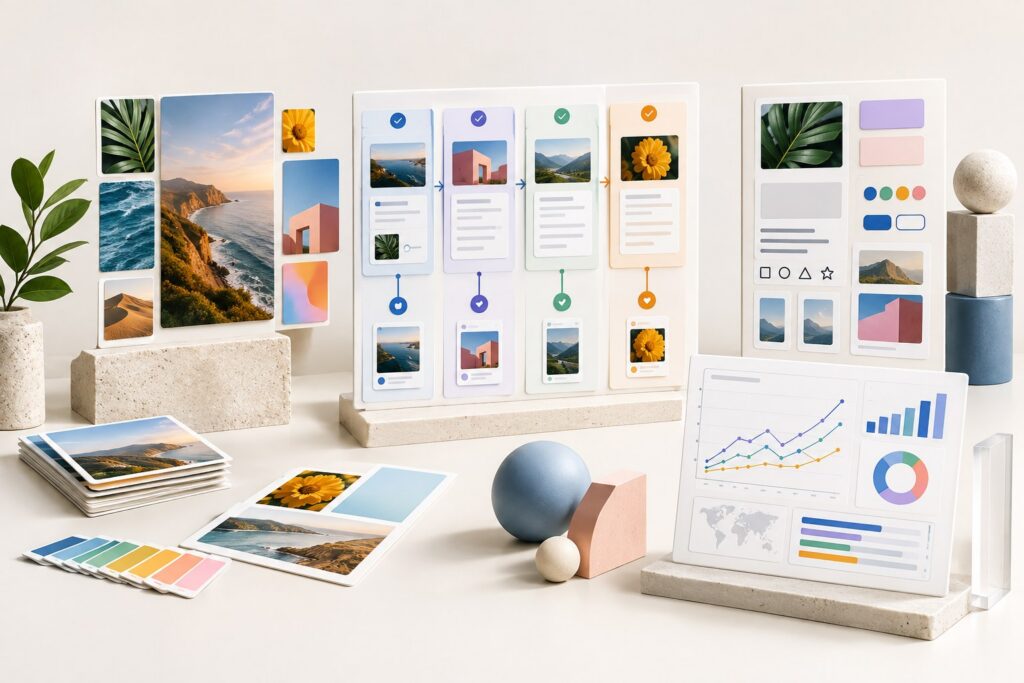
The better AI marketing tools are starting to connect the entire messy middle of marketing: research, ideas, writing, visual production, repurposing, scheduling and publishing. For a small business, that matters because marketing rarely fails from a shortage of ideas. It fails because there are not enough hours to execute them well.
Canva is becoming less like a design tool and more like a campaign workspace
Canva’s AI 2.0 release in 2026 introduced a more agentic creative workflow. Canva says users can generate layered, editable designs from prompts, use connected applications for context, apply brand intelligence and schedule recurring creative tasks.[1]
That is more useful than simply generating a pretty image. A marketing workflow needs revision, brand consistency and several output sizes. Editable design matters because the first draft is almost never the thing you publish.
HubSpot is pulling AI closer to the customer data
HubSpot’s content agent is built into its marketing platform and can use account context and brand settings to help produce campaign assets, social content and other materials. HubSpot says the drafts remain reviewable before publication rather than being automatically pushed live.[2]
That model makes sense. The closer AI gets to the customer relationship, the more valuable context becomes and the more important review remains.
A generic model can write an email. A connected system can know which campaign the email belongs to, what the offer is and how the brand normally sounds.
Design and distribution are beginning to merge
Canva and HubSpot have also integrated their platforms so marketers can create and edit visual assets without constantly moving files between systems.[3]
This sounds minor until you consider how much marketing work is really file logistics. Download the image. Rename it. Upload it. Resize it. Find the latest version. Ask if the blue one is final-final or final-final-2.
The best tools remove those tiny handoffs.
AI video is becoming a normal marketing capability
Video has historically been expensive because production required several specialized steps. Scriptwriting, recording, editing, captions and publishing were separate jobs.
HubSpot now offers AI-assisted scripting, transcript-based editing, captions, translation and direct publishing inside its video tools.[4] Canva and other creative platforms are folding video generation and editing into broader campaign workflows as well.
That makes video more accessible to small teams, but it also raises the quality bar. When everyone can produce more video, simply producing video stops being an advantage.
The real leverage is repurposing
One good piece of source material can now become many useful assets.
A webinar can become a transcript, summary, email, article, short clips, social posts and presentation. A customer interview can become sales language, FAQ content and onboarding material. A product launch brief can become channel-specific creative without rewriting the idea from scratch each time.
This is where AI content creation is most useful. The goal is not to flood every channel. It is to get more value from work you already did.
More content is not automatically better marketing
Canva’s 2026 marketing research found that AI had become standard practice among surveyed marketing leaders, while consumers still expressed concerns about AI-generated advertising that felt generic or lacked something human.[5]
That tension is important. AI makes production easier at the same moment audiences become better at ignoring mediocre production.
The scarce resource is not content. It is relevance.
A small team should therefore use AI to increase the number of good ideas it can execute, not the amount of disposable material it can publish.
Build a small stack, not a software collection
You probably do not need eight AI tools for marketing.
You need a system for research, writing, visual production and distribution. Sometimes one platform can cover several of those jobs. Sometimes two or three specialized tools make more sense.
Start by identifying the places where work repeatedly stalls. If design is the bottleneck, fix design. If every campaign dies because nobody writes the follow-up email, fix that. If one video sits unused after publication, build a repurposing workflow.
The goal is not to become an AI-powered marketing department.
The goal is to make a small marketing operation feel less small.
Sources
[1] Canva, “Introducing Canva AI 2.0: Reimagining how the world creates”
[2] HubSpot, “Create content with content agent”
[3] Canva, “Create, collaborate, and distribute effortlessly with HubSpot and Canva”
[4] HubSpot, “Video Editor and Creation”
[5] Canva, “AI is in. Now comes the hard part: earning consumer trust”
Build your AI fluency.
In the AI Era™ Professional Learning is a five-level certification pathway designed to help professionals move from understanding AI to applying it with greater confidence, productivity, and sophistication.