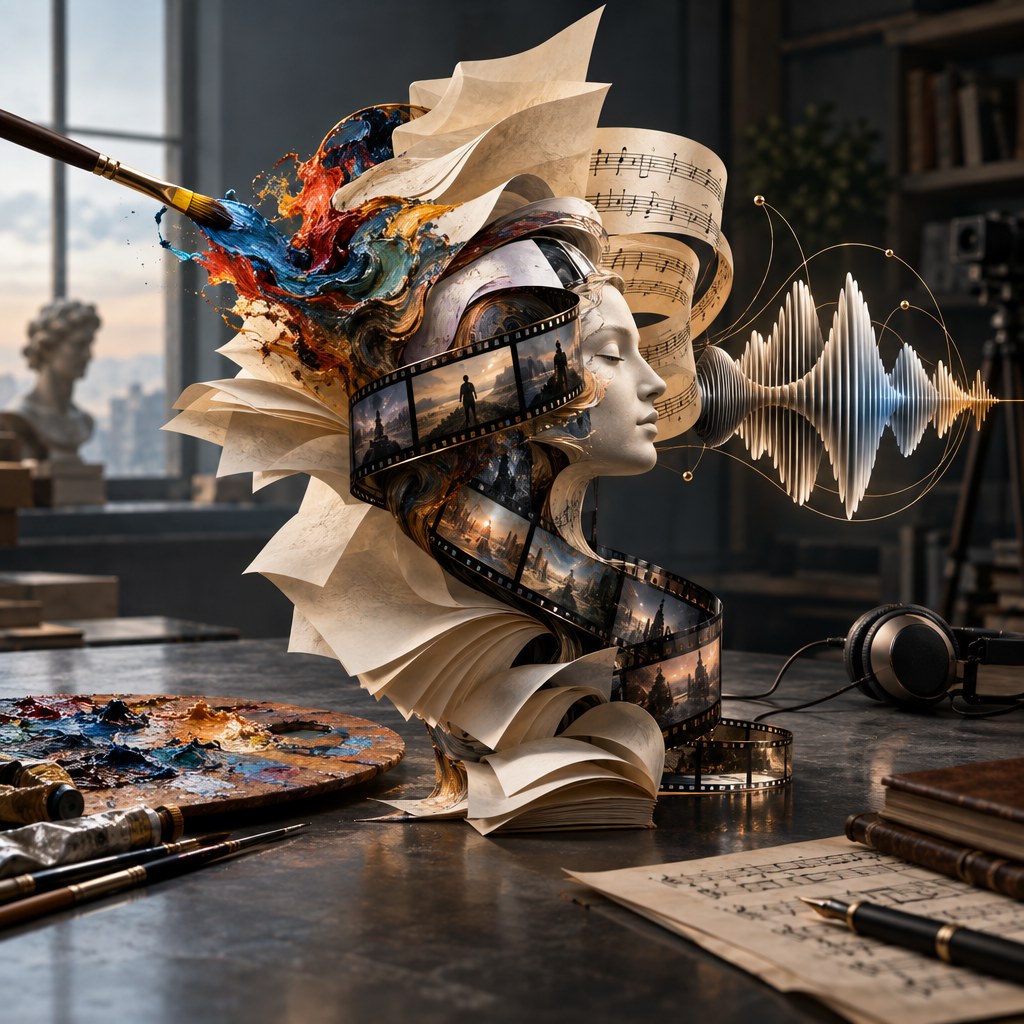
For most of history, having an idea was only the beginning. You also had to be able to do something about it. The song required an instrument. The photograph required a camera and a darkroom. The film required equipment, people and money. The illustration required a hand capable of persuading a pencil to behave. Technology has spent generations reducing those barriers. Generative AI has attacked them with unusual enthusiasm.
Type a sentence and there is an image. Describe a mood and there is music. Ask for a video and, increasingly, there is something moving on the screen that did not exist several minutes earlier. The result is an extraordinary expansion of who can make things, but it also creates a less comfortable question: if making becomes easy, what becomes valuable?
The scarce thing is moving
We have historically attached creative value partly to execution because execution was difficult. A technically accomplished painting told you something about the person who painted it. A beautifully produced record implied access to instruments, equipment, experience and people who knew how to use all three. AI weakens that relationship. A person without traditional illustration skills can now produce sophisticated AI art. Someone without years of audio engineering can experiment with AI music. Generative video is lowering barriers that once made moving images especially expensive to produce.
That does not automatically make the work good. It makes production less scarce. And when production becomes less scarce, other things become more visible: taste, selection, point of view, restraint, and the ability to know which of fifty possibilities deserves to become the final one.
Creators are already using AI without handing it the final decision
The conversation around AI creativity is often framed as a choice between human creation and machine creation. Real creative work is becoming considerably messier. Adobe’s 2026 Creators’ Toolkit Report surveyed more than 16,000 creators and found that 75 percent of respondents who use or have tried creative AI described it as integrated into or essential to their workflow. At the same time, 85 percent said the final creative decision should remain with the creator, while 57 percent said AI outputs generally required moderate or extensive editing before they were ready to share.[1]
That sounds less like replacement than a rearrangement of labor. The machine can produce options quickly. The person increasingly decides what deserves to survive.
Abundance creates its own problem
Consider what happens when the cost of generating an image approaches zero. You do not merely get more good images. You get more images. Much more. The same is happening with AI writing, AI video and AI-generated music. Creation becomes easier at precisely the moment attention remains stubbornly finite.
We may therefore be entering a strange creative economy in which production capacity explodes while the ability to make someone care becomes more valuable. This is not unprecedented. Digital photography did not make great photography irrelevant because everyone suddenly carried a camera. Desktop publishing did not make good design disappear because anyone could select a font. Accessibility expands participation. It also produces oceans of mediocre work. AI may simply produce the ocean faster.
Taste starts looking suspiciously practical
Taste can sound like one of those vague qualities people invoke when they would rather not explain why one chair looks better than another. AI is giving it a more concrete role. When a system can generate twenty competent directions in a minute, somebody still has to know which direction is interesting.
That judgment requires context. Does this feel derivative? Is it appropriate for the audience? Does it say anything? Is it technically polished but emotionally vacant? Has somebody already made this exact thing six thousand times? Those questions are difficult to automate because their answers are partly cultural. A machine can learn patterns. Culture cares about when to break them.
Authorship is becoming more complicated too
There is also a legal reason human contribution matters. The U.S. Copyright Office concluded in 2025 that material produced with generative AI can receive copyright protection where sufficient human-authored expressive elements are present, but purely machine-determined expressive output is not protected simply because someone supplied prompts.[2]
That distinction will continue to matter as AI becomes embedded inside creative tools. Using AI does not erase authorship, but authorship increasingly depends on what the human actually contributed. Selection, arrangement, editing, transformation and creative direction may become more important not only aesthetically, but legally.
The most interesting work may not look like AI work
Every new creative technology spends an awkward period announcing itself. Early digital effects wanted you to notice that they were digital effects. Early websites had a remarkable fondness for proving that text could blink. AI is still in that phase. There is AI art that looks determined to remind you it was generated. There is AI writing with a recognizable smoothness. There are videos whose appeal is mostly the surprise that a machine produced them at all.
That novelty will fade. The more interesting question is what happens when AI stops being the subject and simply becomes one of the instruments. Anthropic’s 2026 creative-work initiative, for example, introduced connectors intended to let Claude work alongside software that creative professionals already use rather than replacing the entire process.[3] That seems closer to where things are going. The electric guitar mattered because people made music with it, not because the world needed songs about electric guitars.
Creativity may become more human, not less
There is a pessimistic version of the AI future in which culture becomes an infinite feed of statistically competent material. That is possible. There is another version in which the ability to execute an idea becomes widely available, allowing more people to participate in forms of expression that were previously inaccessible to them. That is possible too. Both can be true.
AI can produce enormous quantities of mediocre work while enabling someone without technical training to make something genuinely personal. The technology does not settle the question. People do. And that may be the most interesting consequence of all.
When almost anyone can produce something polished, polish loses some of its authority. The question shifts from Can you make this? to Why did you make this? Machines are becoming very good at the first question. The second remains stubbornly ours.
Sources
[1] Adobe, “2026 Creators’ Toolkit Report”
[2] U.S. Copyright Office, “Copyright and Artificial Intelligence, Part 2: Copyrightability”
[3] Anthropic, “Claude for Creative Work”
Build your AI fluency.
In the AI Era™ Professional Learning is a five-level certification pathway designed to help professionals move from understanding AI to applying it with greater confidence, productivity, and sophistication.